Hand-painted in oil
About this Artwork
An attribute painted on a container
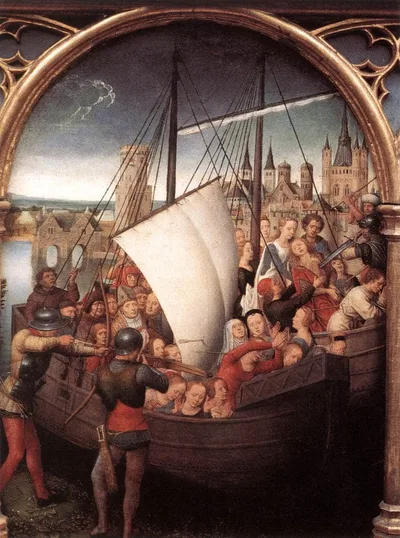
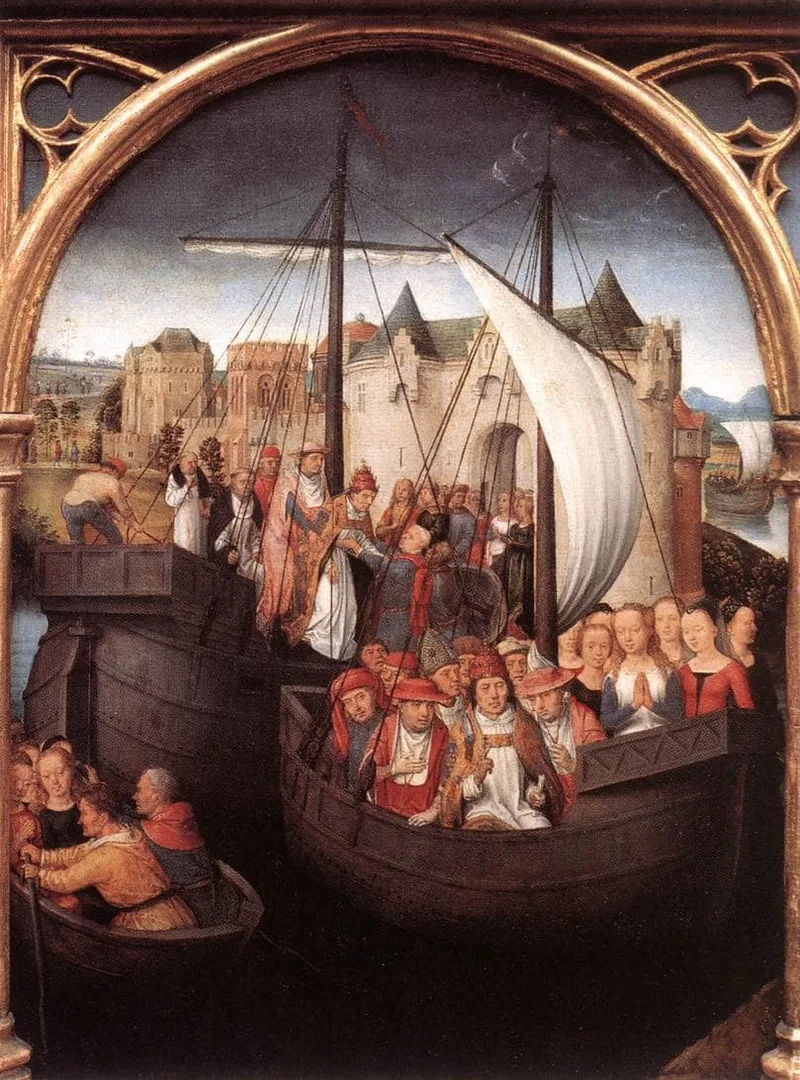
Ursula's sign is an arrow, and her second sign is a crowd — the company of young women the legend sends with her. The entry recorded here is not a picture in the ordinary sense but a panel from a reliquary: an object built to hold remains, with the story of the person painted on its sides. That changes what the attribute is for. On a wall, the arrow tells a viewer who is being shown. On a casket, it tells a viewer what is inside.
What the record holds
The catalogue dates the panel to 1489 and gives the Memling Museum (Old St. John's Hospital), Bruges, Belgium as its location. No dimensions are recorded in this entry. It is filed under group portraiture, cultural heritage and religious cultural heritage, with Northern Renaissance as the style and Flemish as the nationality; the measured colour family is red.
One object, two entries
4 titles in this catalogue contain her name, and two of them — this departure scene and a martyrdom at Cologne — are recorded as panels from the same shrine, both carrying the same date and the same location. A catalogue built one image at a time takes a single object apart and files the sides separately. The record is accurate about each panel and says nothing about the thing they were cut from, beyond what the titles preserve.
Sources
2 references- Memling, Hans, School of — Getty ULAN
Unknown artist
- Hans Memling — Wikipedia
Hans Memling (also spelled Memlinc; c. 1430 – 11 August 1494) was a German-Flemish painter who worked in the tradition of Early Netherlandish painting. Born in the Middle Rhine region, he probably spent his childhood in Mainz. During his ap