Hand-painted in oil
About this Artwork
The eagle, and the island
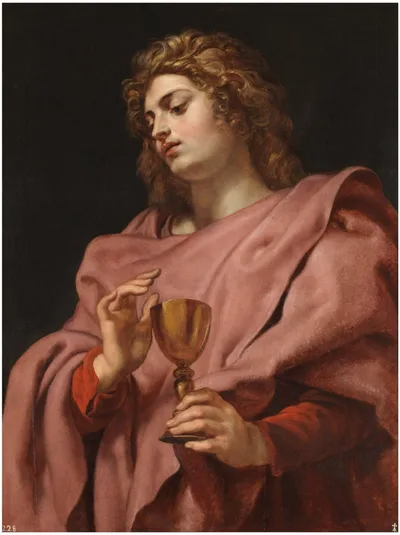
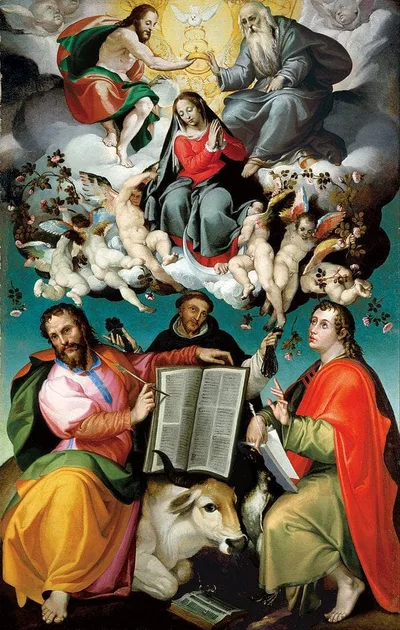
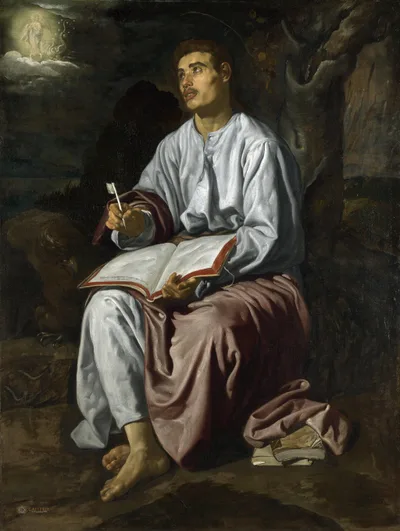
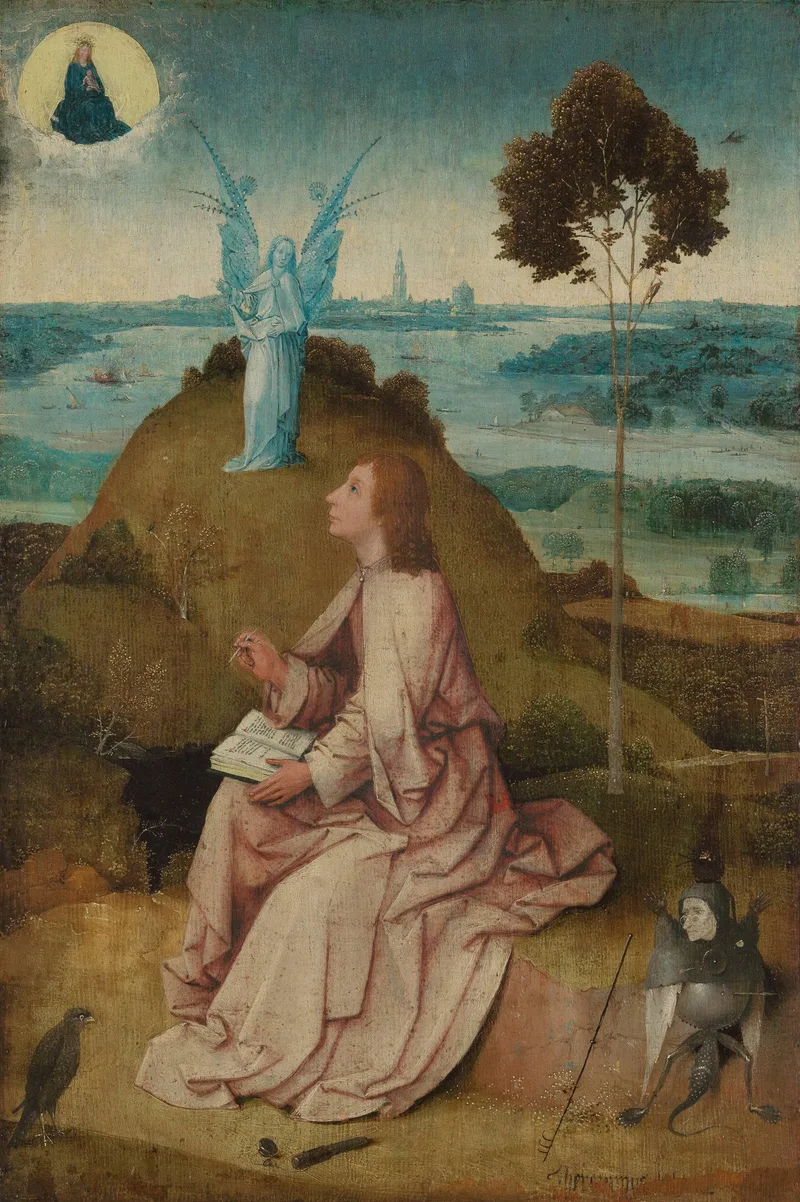
John the Evangelist is given an eagle. The symbol comes from the four-creature scheme that assigns a winged man to Matthew, a lion to Mark, an ox to Luke and the eagle to John, and it identifies him wherever it appears. A second sign is a place rather than a thing: Patmos, the island to which tradition sends him and on which the Book of Revelation is said to have been written. The title recorded here uses both — the name and the island — so the picture arrives already labelled.
What the record holds
The catalogue dates the panel to 1485 and locates it at the Gemäldegalerie, Berlin. Its dimensions are 63 x 43.3 cm, a small upright. The categories are broad: Religion and religious cultural heritage, mythology, and Fantasy. The style is Northern Renaissance, the nationality Dutch, and the measured colour families are ochre and green.
Why Fantasy sits in the categories
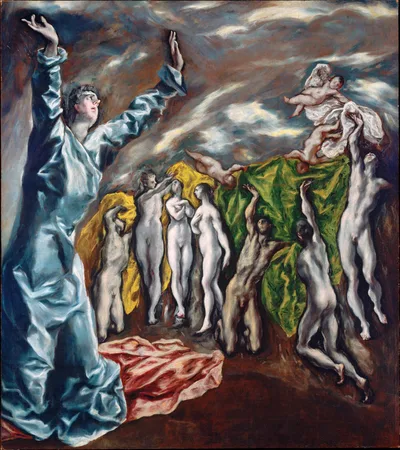
The Fantasy tag is a subject-index decision, and for a Revelation subject it is a reasonable one. The text this saint is associated with is composed of visions — beasts, signs in the sky, a woman clothed with the sun — and a catalogue that indexes what a picture depicts has to file such things somewhere. The eagle still identifies the man; the tag describes what he is looking at.
Sources
8 references- Hieronymus Bosch — Wikipedia
Hieronymus Bosch (; Dutch: [ɦijeːˈroːnimʏz ˈbɔs] ; born Jheronimus van Aken [jeːˈroːnimʏs fɑn ˈaːkə(n)]; c. 1450 – 9 August 1516) was a Dutch painter from Brabant. He is one of the most notable representatives of the Early Netherlandish pai
- Bosch, Hieronymus — Getty ULAN
Netherlandish painter, draftsman, ca. 1450-1516
- St. John on Patmos — Wikidata
description: painting by Hieronymus Bosch; inception: 1489; dimensions: 63 × 43.3 cm; collection: Gemäldegalerie Berlin
- id.smb.museum — record for "St. John on Patmos"
Primary source record for this work (id.smb.museum).
- St. John the Evangelist on Patmos — Wikipedia
St. John on Patmos is an oil on panel painting by the Netherlandish artist Hieronymus Bosch, created c. 1489. The painting is held in the Gemäldegalerie, in Berlin, Germany. The reverse is also painted, the title of that picture is Scenes f
- jstor.org — reference for "St. John the Evangelist on Patmos"
Authoritative source for this work (jstor.org).
- recherche.smb.museum — reference for "St. John the Evangelist on Patmos"
Authoritative source for this work (recherche.smb.museum).
- Hieronymus Bosch St. John the Evangelist on Patmos about 1500 Gemäldegalerie Berlin 9346 — Wikimedia Commons
High-resolution image of the work, hosted on Wikimedia Commons.