Hand-painted in oil
About this Artwork
Named by office, not by martyrdom
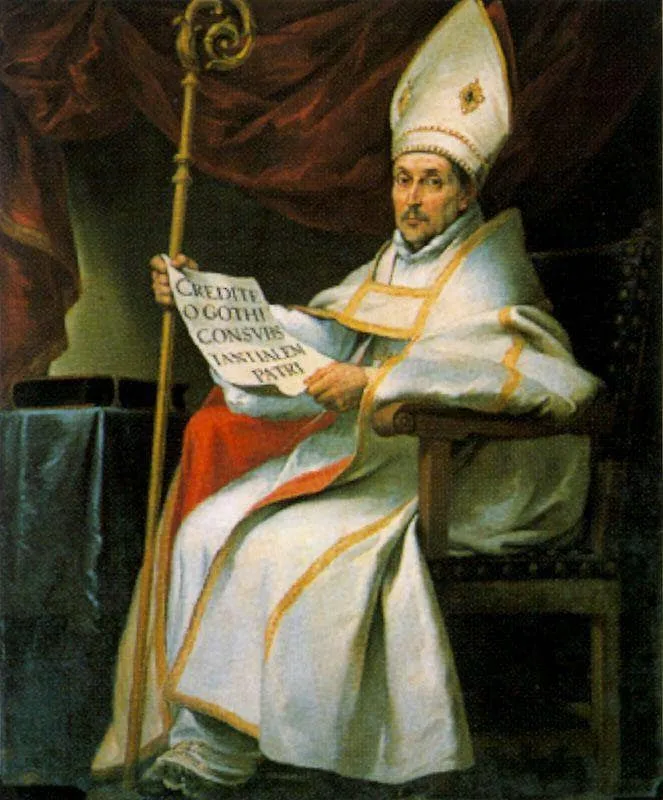
Most of the saints in this collection are identified by an instrument of death. Leander belongs to the other class entirely: he is remembered as a bishop of Seville and a writer, and painting names him with the equipment of that office — mitre, crozier, a book, episcopal vestments. There is no wheel, no arrow, no grill. Where a martyr's attribute points backward to how the story ended, a bishop's attribute points at what the man did for a living. This is the only title in the collection that names him.
What the record holds
The catalogue dates the work to 1655 and gives Seville Cathedral, recorded as Santa María de la Sede, as its location. That is worth noticing on its own: the location field here names a working church rather than a museum, which most entries in this collection do not. No dimensions are recorded. It is filed under male portraiture, Religion and religious cultural heritage, with Baroque as the style and Spanish as the nationality; the measured colour family is yellow.
A local saint in a local building
A bishop of Seville, catalogued in Seville, is a case where the subject and the address agree. The record establishes both facts and nothing beyond them; how the picture came to be there is not something this entry records, and it is not guessed at here.
Sources
3 references- Murillo, Bartolomé Estebán — Getty ULAN
Spanish painter and draftsman, 1618-1682
- Bartolomé Esteban Murillo — Wikipedia
Bartolomé Esteban Murillo ( mure-IL-oh, m(y)uu-REE-oh, Spanish: [baɾtoloˈme esˈteβam muˈɾiʎo]; late December 1617, baptised 1 January 1618 – 3 April 1682) was a Spanish Baroque painter. Although he is best known for his religious works, Mur
- Leander of Seville — Wikipedia
Leander of Seville (Spanish: Leandro de Sevilla; Latin: Leandrus; c. 534 AD – 13 March 600 or 601) was a Hispano-Roman Catholic prelate who served as Bishop of Seville. He was instrumental in effecting the conversion of the Visigothic kings