Hand-painted in oil
About this Artwork
Stones, and the first of the martyrs
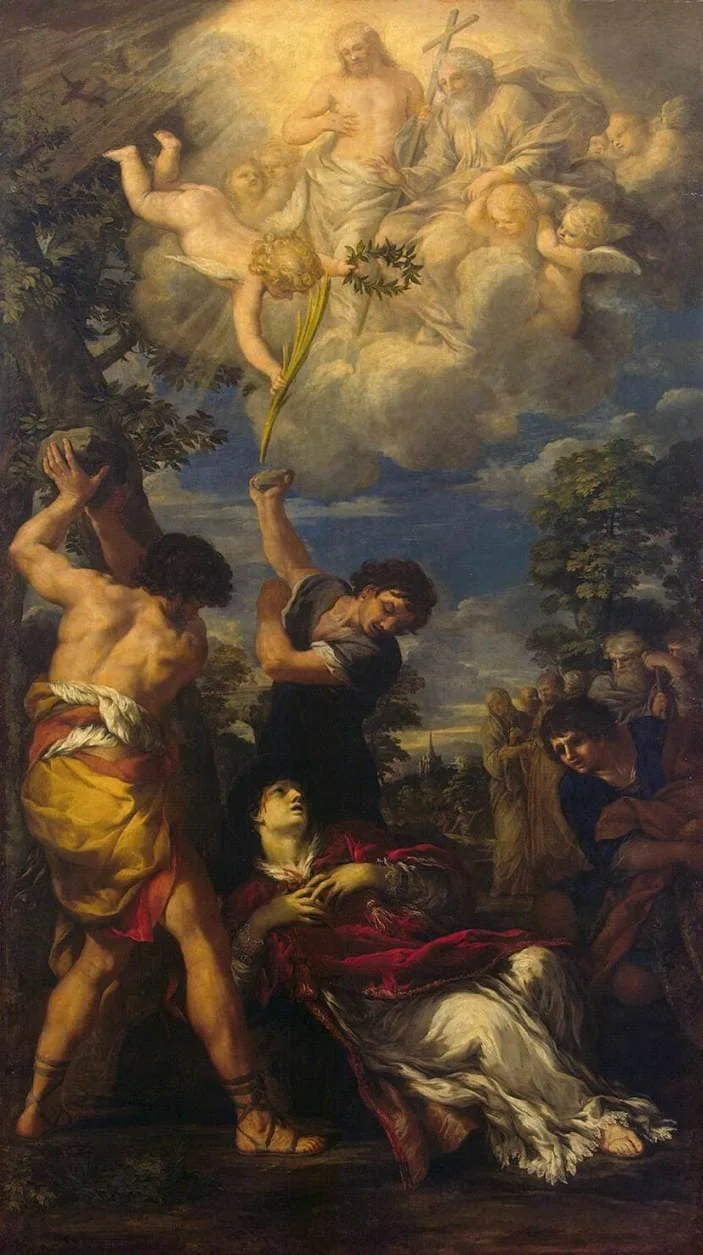
Stephen is identified by stones — often shown resting on his head or shoulders, which is the tradition's way of turning a weapon into a portable emblem — and by the dalmatic of a deacon, since he is remembered as one. A martyr's palm and a book complete the set. He belongs to a small group of saints whose attribute is the material of the killing rather than a manufactured instrument, and the stones are correspondingly plain: no wheel, no grill, no blade, just rock. 2 titles in this collection name Stephen.
What the record holds
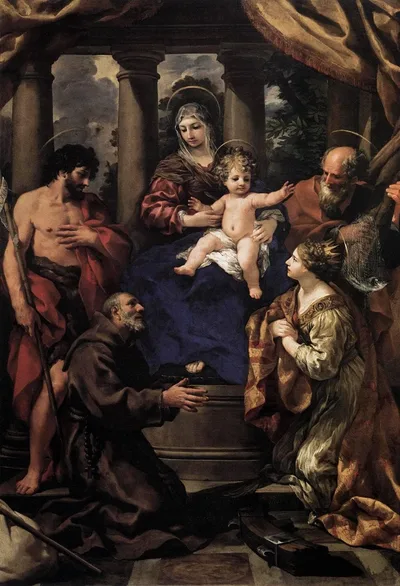
The catalogue dates the canvas to 1660 and gives the Hermitage Museum in Saint Petersburg as its location. The dimensions are 261 x 149 cm — tall, and considerably larger than most entries here. It is filed under Religion, Fantasy, and religious and mythological cultural heritage, with Baroque as the style and Italian as the nationality; the measured colour family is ochre.
What the vertical format has to hold
A stoning is an event that happens at ground level, and a canvas nearly three times as tall as this one is wide has to put something in the upper half. In Baroque practice that space is usually given to a vision or to an opening sky, which is what the Fantasy tag on this entry most often marks elsewhere in the collection. The record establishes the proportion and the tag; it does not describe the composition, and neither does this page.
Sources
1 references- Urbano da Cortona — Getty ULAN
Italian sculptor, ca.1426-1504