Hand-painted in oil
About this Artwork
Attributes are a technology for distance
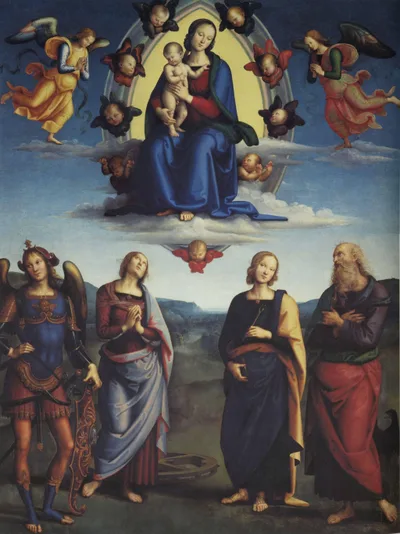
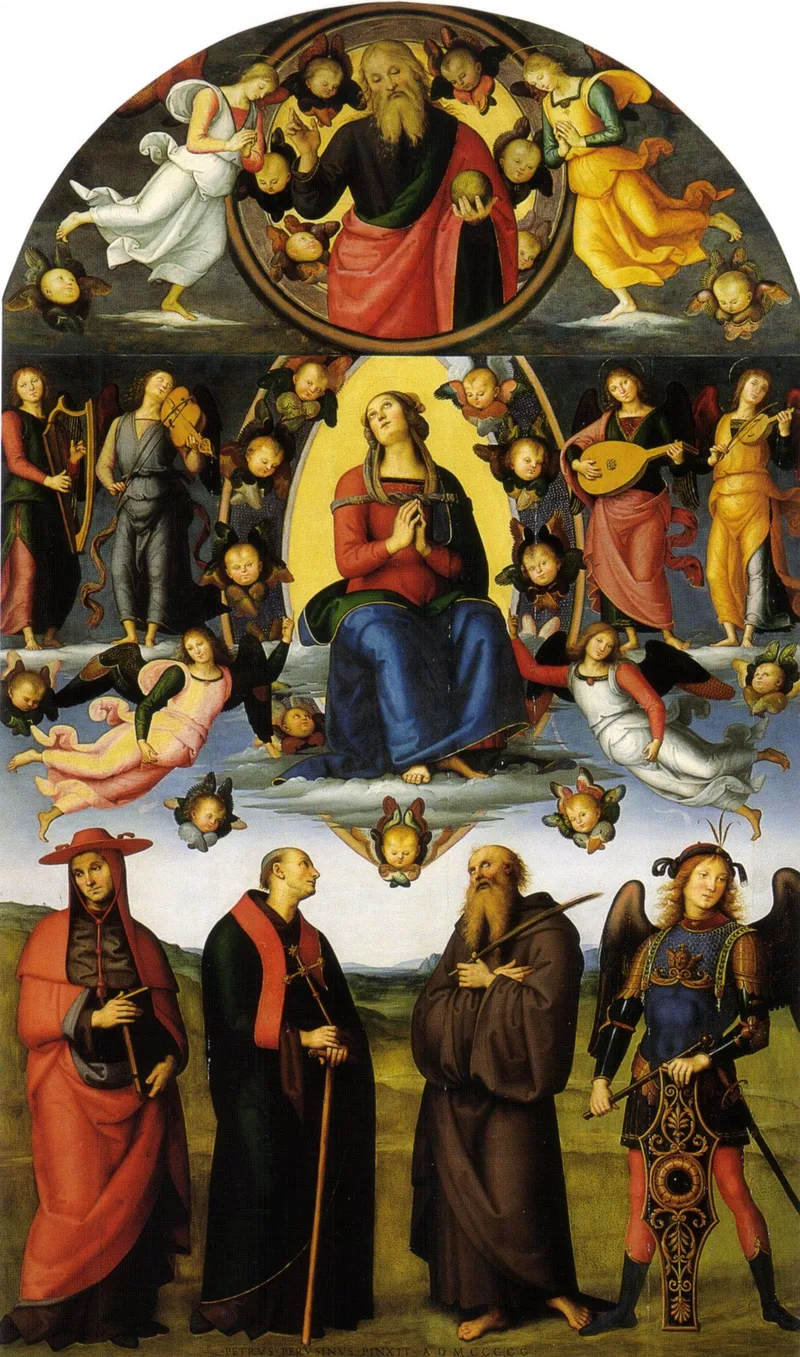
This entry records an altarpiece, and its dimensions explain what the whole convention is for. At 246 x 415 cm the picture is a wall. Nobody meets it at arm's length; it is read from a floor, by people at the far end of a room, in the light available. Under those conditions a face is a smudge and an object is not. A tower, a wheel, a lion, a set of keys — these are shapes that survive distance, and the reason saints carry them is that the alternative is an unreadable crowd.
What the record holds
The catalogue dates the work to 1500 and gives the Galleria dell'Accademia di Firenze, Florence, Italy as its location. The dimensions are 246 x 415 cm. It is filed under Religion, cultural heritage in both headings, and Architectural, with High Renaissance as the style and Italian as the nationality; the measured colour family is brown.
Named for a place, filled with the unnamed
The title carries the name of the abbey the work was made for and then says only saints. That combination is common in this catalogue: 65 of its 611 titles use the plural without identification. The record can give the address and the measurement. Which saints stand in the picture is information that lives in the objects, and the entry does not carry it.
Sources
4 references- Montanini, Pietro — Getty ULAN
Italian painter and draftsman, 1626-1689
- Pietro Perugino — Wikipedia
Pietro Perugino (US: PERR-ə-JEE-noh, -oo-; Italian: [ˈpjɛːtro peruˈdʒiːno]; born Pietro Vannucci or Pietro Vanucci; c. 1446/1452 – 1523) was an Italian Renaissance painter of the Umbrian school who developed some of the qualities that foun
- Perugino — Getty ULAN
Italian painter and draftsman, ca. 1450-1523
- Pietro Perugino - Assumption of the Virgin with Four Saints - WGA17280 — Wikimedia Commons
High-resolution image of the work, hosted on Wikimedia Commons.