Hand-painted in oil
About this Artwork
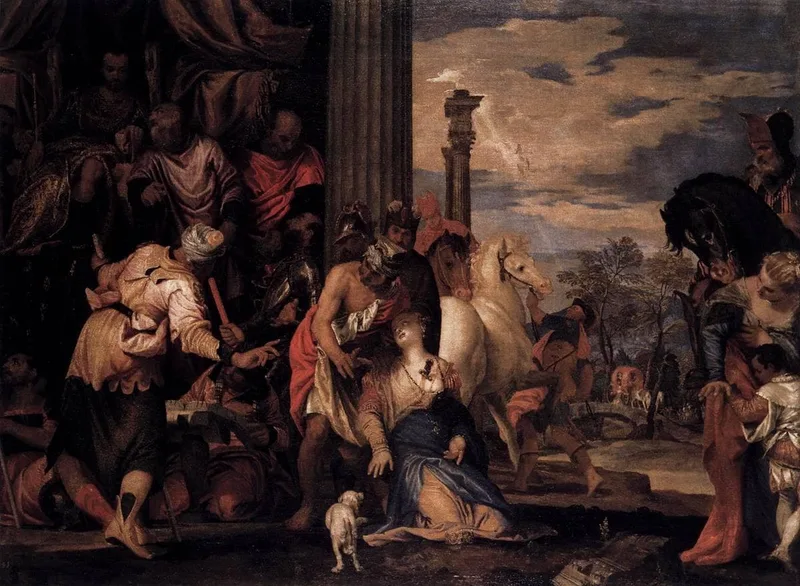
A sword, and a unicorn
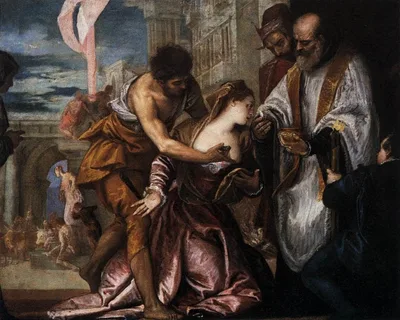
Justina of Padua is given two signs and they could not be less alike. The first is a sword through the breast, the instrument the legend supplies for her death, and it belongs to the largest family of attributes in Christian art — the tool that killed the saint, held by the saint afterwards. The second is a unicorn, which is an emblem of her city's association rather than an event in her life, and which functions as a badge. One names the person; the other names where she is venerated.
What the record holds
The catalogue dates the work to 1575 and gives the Uffizi Gallery, Florence, Italy as its location. Its dimensions are 103 x 113 cm, close to square. It is filed under group portraiture, Religion, cultural heritage in both headings, and Fantasy, with Mannerism Late Renaissance as the style and Italian as the nationality; the measured colour families are brown and red.
One entry, one name
Hers is the only title in this catalogue that contains the name Justina. That scarcity is not a judgement on the picture; it reflects how the attribute system distributes attention, favouring saints whose signs are portable and unmistakable over saints whose identification depends on a local cult. The Fantasy heading on the entry is doing straightforward work — an index that records what a picture contains needs somewhere to file an animal that does not exist.
Sources
5 references- Caliari, Carlo — Getty ULAN
Italian painter, 1570-1596
- Paolo Veronese — Wikipedia
Paolo Caliari (1528 – 19 April 1588), known as Paolo Veronese ( VERR-ə-NAY-zay, -zee, US also -see; Italian: [ˈpaːolo veroˈneːze, -eːse]), was an Italian Renaissance painter based in Venice, known for extremely large history paintings of
- The Martyrdom of Saint Justina — Wikidata
description: painting by Paolo Veronese, Uffizi; inception: 1555; dimensions: 103 × 113 cm; collection: Uffizi Gallery
- The Martyrdom of Saint Justina — Wikipedia
The Martyrdom of Saint Justina is a c.1570–1575 oil-on-canvas painting by the Italian painter Paolo Veronese, with assistance from his younger brother. It was originally produced for Santa Giustina Basilica in Padua and now is held in the U
- Martyrdom of Saint Justina by Paolo Veronese - Main altar - Santa Giustina - Padua 2016 — Wikimedia Commons
High-resolution image of the work, hosted on Wikimedia Commons.