Hand-painted in oil
About this Artwork
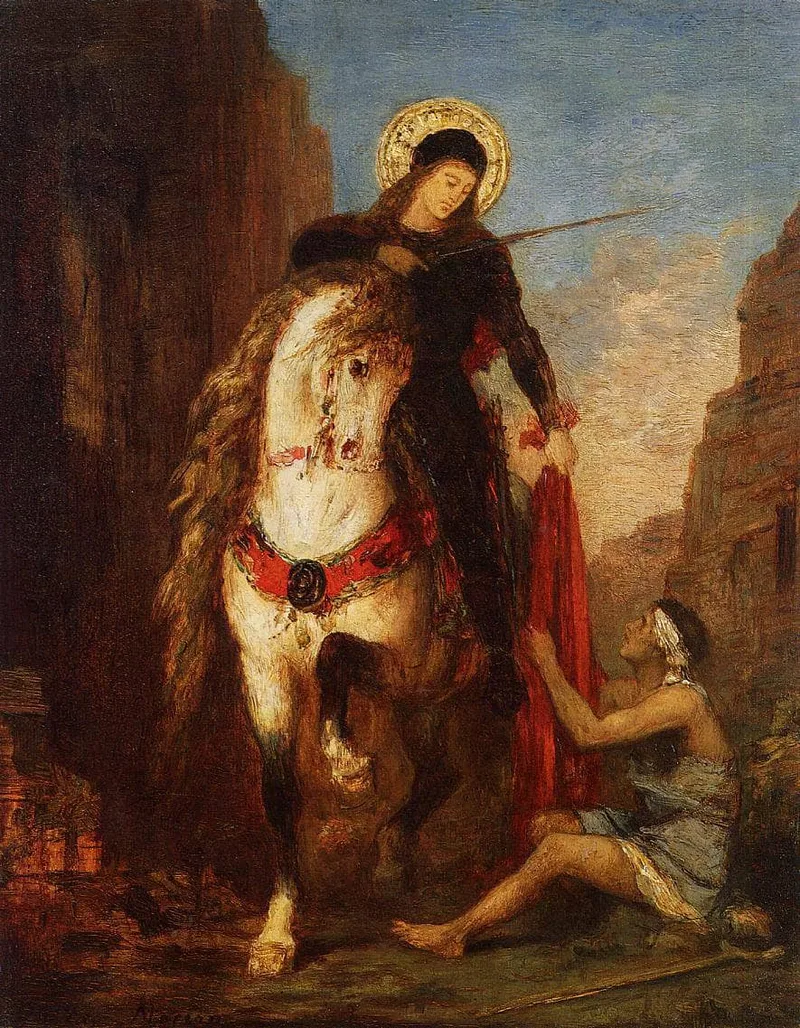
The cloak cut in half
Martin of Tours is named by an act of division. The tradition has him, as a soldier, cut his military cloak in two with his sword and give half to a beggar, and painters have used that single motion as his sign for more than a thousand years: a mounted man, a blade, a divided garment, a figure on the ground. It is one of the few attributes that requires two people. A wheel can be handed to a saint standing alone; half a cloak means nothing without the person holding the other half.
What the record holds
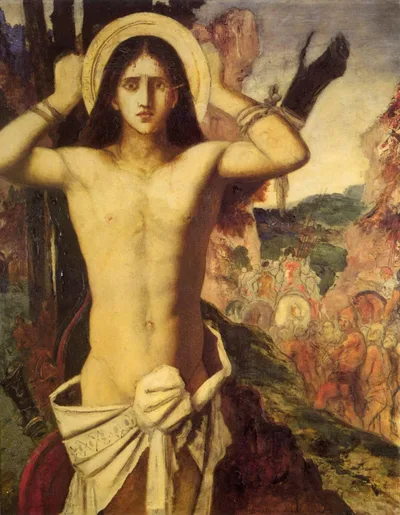
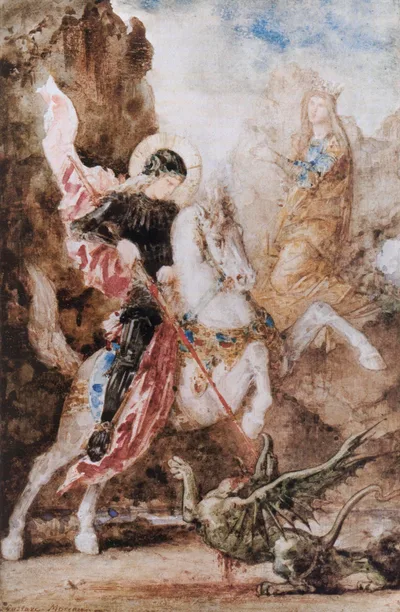
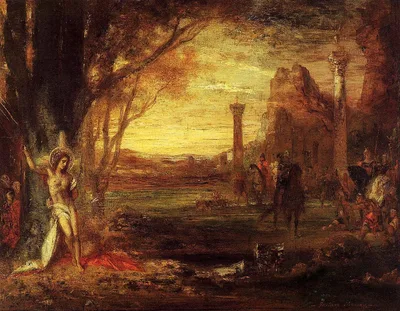
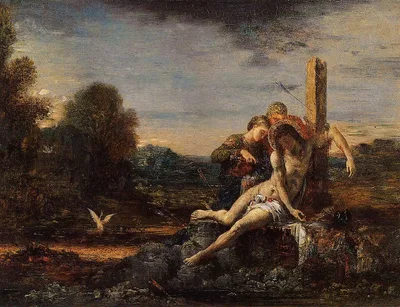
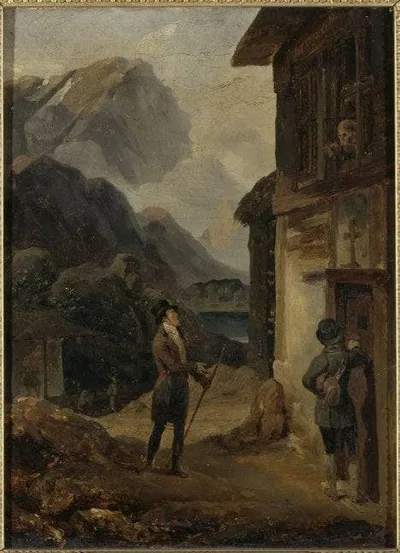
The entry is dated 1882 and gives Private Collection as its location. No dimensions are recorded. It is filed under Religion, cultural heritage in both its religious and mythological headings, Vintage and Fantasy, with Symbolism as the style and French as the nationality; the measured colour family is brown.
Ten Martins, and most of them are water
The name appears in 10 titles in this catalogue and only three of them belong to the saint. The rest are geography: 5 entries for a canal in Paris, one for a street, one for a waterfall near Pontoise — painted by nineteenth-century landscapists who were recording an address. It is the clearest case in this collection of a saint's name outliving its owner and being reassigned to infrastructure — and it is the reason an entry like this one has to say which Martin is meant.
Sources
5 references- Musée Gustave Moreau — Getty ULAN
French repository, Paris, contemporary
- Gustave Moreau — Wikipedia
Gustave Moreau (French: [ɡystav mɔʁo]; 6 April 1826 – 18 April 1898) was a French artist and an important figure in the Symbolist movement. Jean Cassou called him "the Symbolist painter par excellence". He was an influential forerunner of s
- Moreau, Gustave — Getty ULAN
French painter, 1826-1898
- Canal Saint-Martin — Wikipedia
The Canal Saint-Martin (French pronunciation: [kanal sɛ̃ maʁtɛ̃]) is a 4.6 km (2.86 mi) long canal in Paris, connecting the Canal de l'Ourcq to the river Seine. Nearly half its length (2,069 metres (2,263 yd)), between the Rue du Faubourg d
- Gustave Moreau-Saint Martin-Cat. 508 — Wikimedia Commons
High-resolution image of the work, hosted on Wikimedia Commons.