Hand-painted in oil
About this Artwork
The attribute nobody agreed on
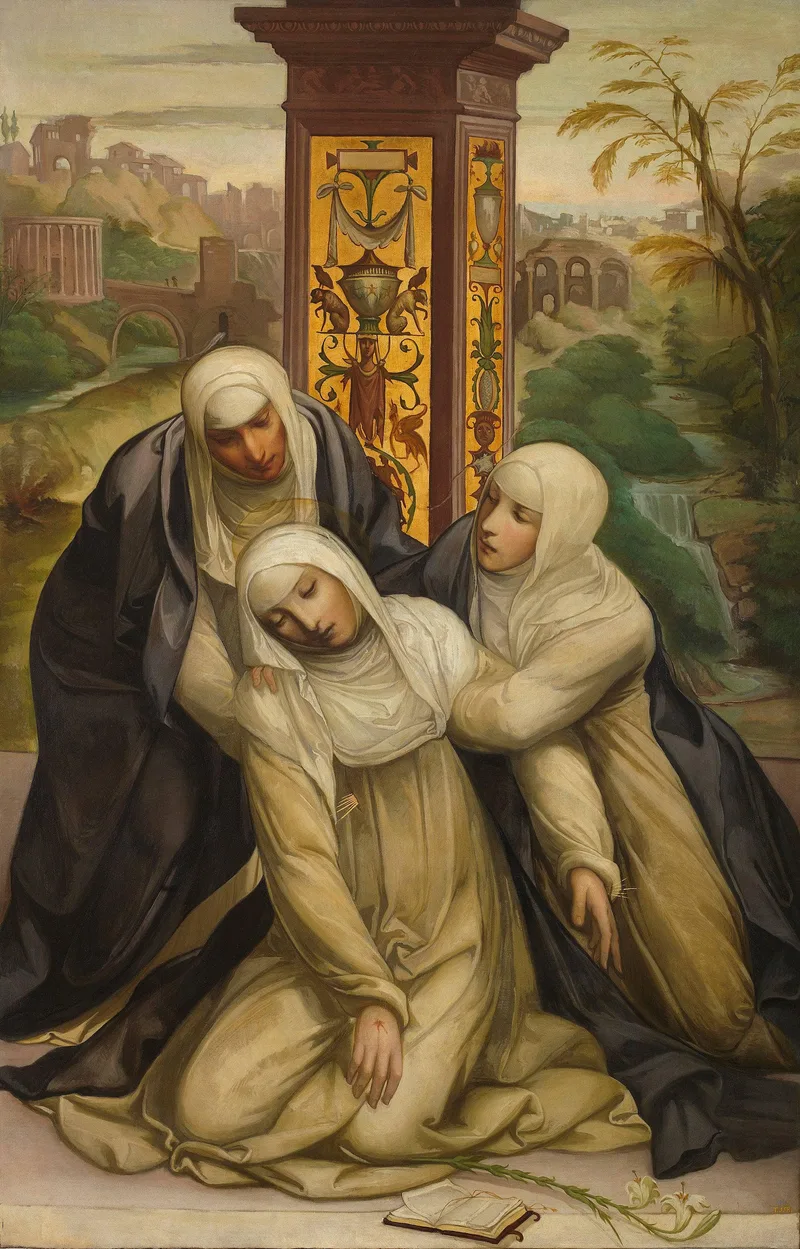
The stigmata — wounds corresponding to those of the crucified Christ — are the identifying mark of Francis of Assisi before they belong to anyone else. Their transfer to Catherine of Siena is a claim made within the tradition rather than a neutral iconographic fact, and it was argued over between religious orders for a very long time. A painting that shows them is taking a side, whether or not it means to. The record indexes the subject without adjudicating it, and this page does not adjudicate it either.
What the record holds
The catalogue dates the canvas to 1862 and gives the Museo del Prado in Madrid as its location. The dimensions are 214 x 134 cm, a tall upright. It is filed under group portraiture and religious cultural heritage, with Purism as the style and Spanish as the nationality; the measured colour family is ochre.
A rare label in the style field
Purism appears on 2 entries in this whole collection, which makes it one of the least used style terms here. The name refers to a nineteenth-century return to the clarity and restraint of early Italian painting, in deliberate reaction against the theatrical manner that preceded it. Applied to a subject three centuries old, the label reports a choice: an artist working in 1862 handling a devotional episode in the visual language of the fifteenth century rather than of his own moment.
Sources
1 references- Rosales Martínez, Eduardo — Getty ULAN
Spanish painter, 1836-1873