Hand-painted in oil
About this Artwork
Matthew's attributes, and how he is told apart
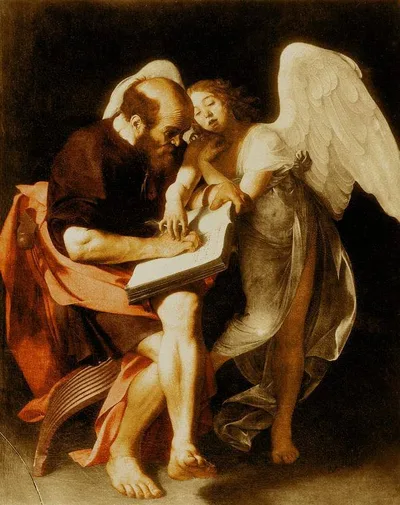
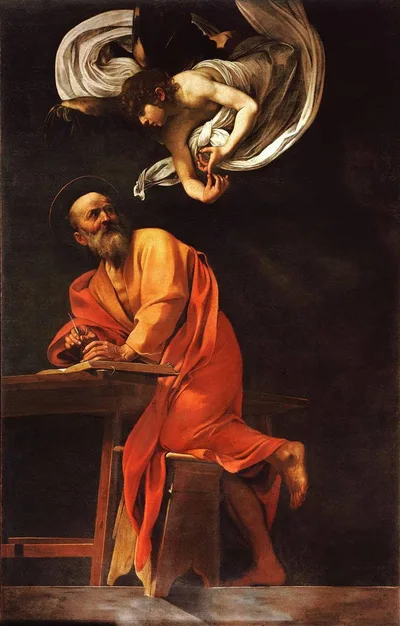
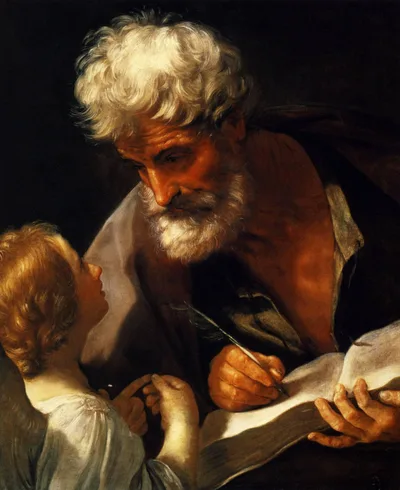
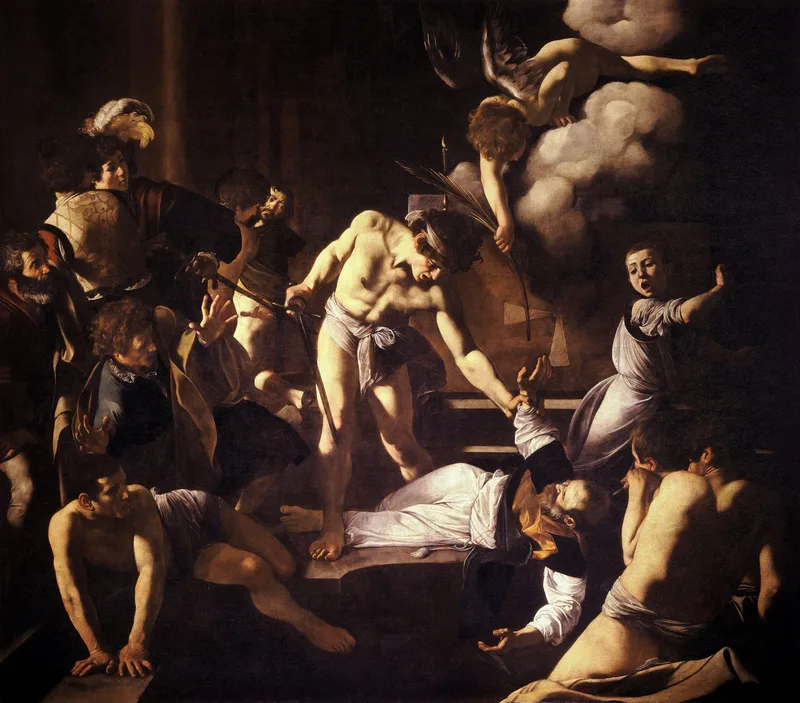
Saint Matthew is identified in Western art by two conventions that work together. As one of the four evangelists he is given a winged man or angel, the symbol assigned to him in a scheme that also gives Mark a lion, Luke an ox and John an eagle; as a martyr he is given the weapon of his death, a sword or a halberd. The title of this work names the martyrdom, and so points to the second of the two. The angel identifies the writer; the blade identifies the death.
What the record holds
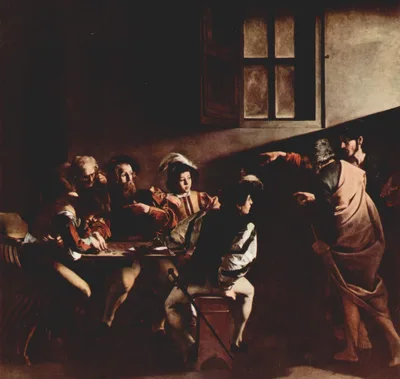
The catalogue gives 1600 as the date of creation and San Luigi dei Francesi in Rome as the location — a church rather than a museum, which is worth noting, since it means the painting is recorded where a congregation meets rather than where a ticket is sold. The dimensions are 323 x 343 cm, close to square and larger than most rooms would take. The record files it under group portraiture, religious cultural heritage and Religion, with Baroque and Tenebrism as styles, and the measured colour family is brown.
Scale and darkness
At that size, tenebrism stops being a matter of taste. A picture of more than three metres a side, built out of shadow with light admitted narrowly, is designed to be legible from a distance in a room with uncertain lighting.
Sources
7 references- Caravaggio, Gianni — Getty ULAN
Italian sculptor and installation artist, born 1968
- Caravaggio — Wikipedia
Michelangelo Merisi da Caravaggio (also Michele Angelo Merigi or Amerighi da Caravaggio; 29 September 1571 – 18 July 1610), known mononymously as Caravaggio, was an Italian painter active in Rome for a significant portion of his artistic li
- Caravaggio, Cecco del — Getty ULAN
Italian painter, active ca. 1610-1620
- The martyrdom of Saint Matthew — Wikidata
description: painting by Caravaggio; inception: 1599-01-01; dimensions: 323 × 343 cm
- rkd.nl — record for "The martyrdom of Saint Matthew"
Primary source record for this work (rkd.nl).
- The Martyrdom of Saint Matthew (Caravaggio) — Wikipedia
The Martyrdom of Saint Matthew (Italian: Martirio di San Matteo; 1599–1600) is a painting by the Italian master Michelangelo Merisi da Caravaggio. It is located in the Contarelli Chapel of the church of the French congregation San Luigi dei
- The Martyrdom of Saint Matthew-Caravaggio (c. 1599-1600) — Wikimedia Commons
High-resolution image of the work, hosted on Wikimedia Commons.