Hand-painted in oil
About this Artwork
Snow and doves
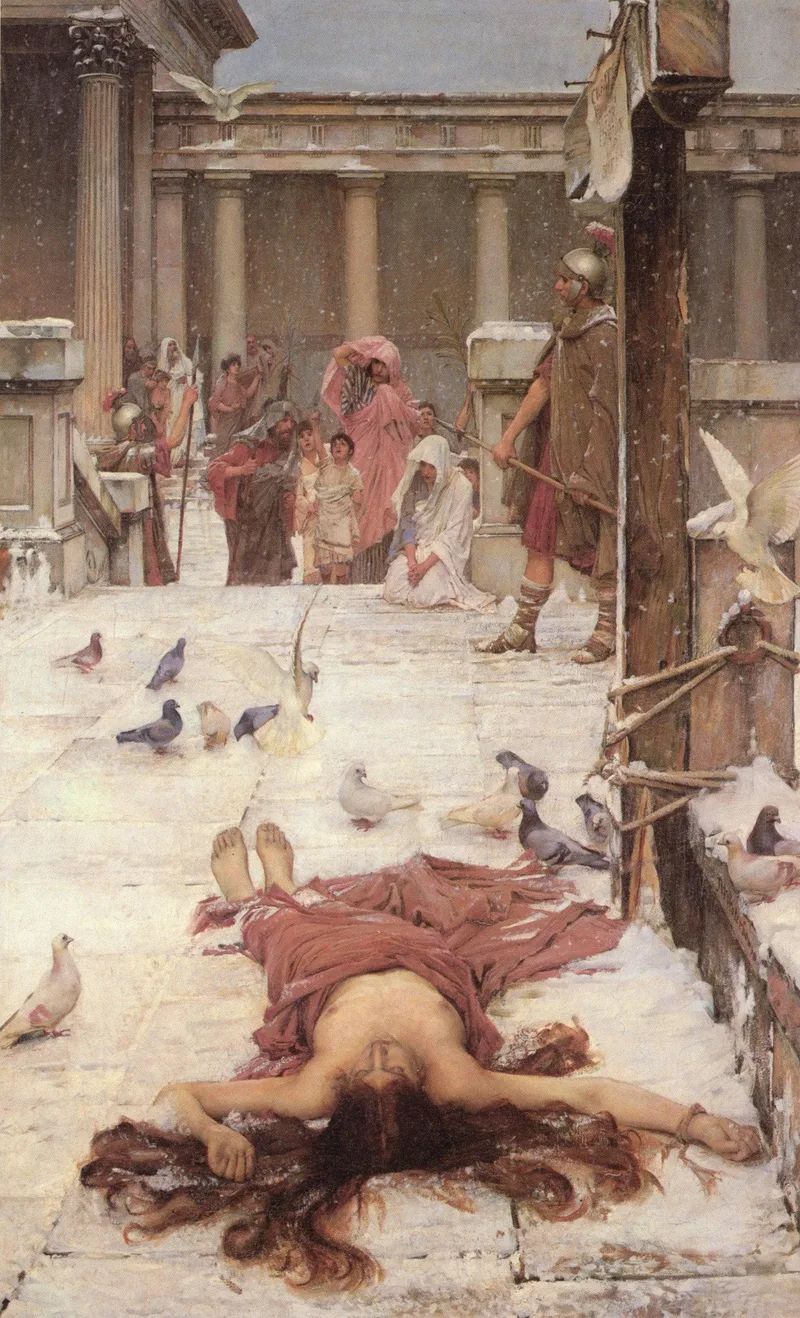
Eulalia of Mérida is identified less by an object than by two events her legend supplies: a fall of snow said to have covered her body after her death, and a dove said to have left it. The convention is narrower than a wheel or a set of keys, and it depends on the whole scene rather than on a single held item — which is why a picture of Eulalia usually shows her fallen, on the ground, with white above and birds nearby.
What the record holds
The catalogue dates the canvas to 1885 and gives Tate Britain, London, as its location. The dimensions are 188.6 x 117.48 cm, a large upright. Two of the categories filed against it are worth reading together: alongside Religion and religious cultural heritage, the record indexes the work under Animal Art with Bird as a subheading. The style is given as Romanticism, the nationality British, and the measured colour family is ochre.
A nineteenth-century saint
The date sets this apart from most of the martyr subjects in the collection by two or three hundred years. By 1885 an image of an early Christian martyr is not an altarpiece; it is a history painting, made for exhibition and for a public that read such stories as antiquity rather than as liturgy. The attributes survive the change intact — the snow and the bird still name her.
Sources
2 references- Waterhouse, John William — Getty ULAN
British painter, 1849-1917
- Saint Eulalia — Tate
Tate open data: Waterhouse, John William; exhibited 1885; Oil paint on canvas