Hand-painted in oil
About this Artwork
An attribute that is a companion
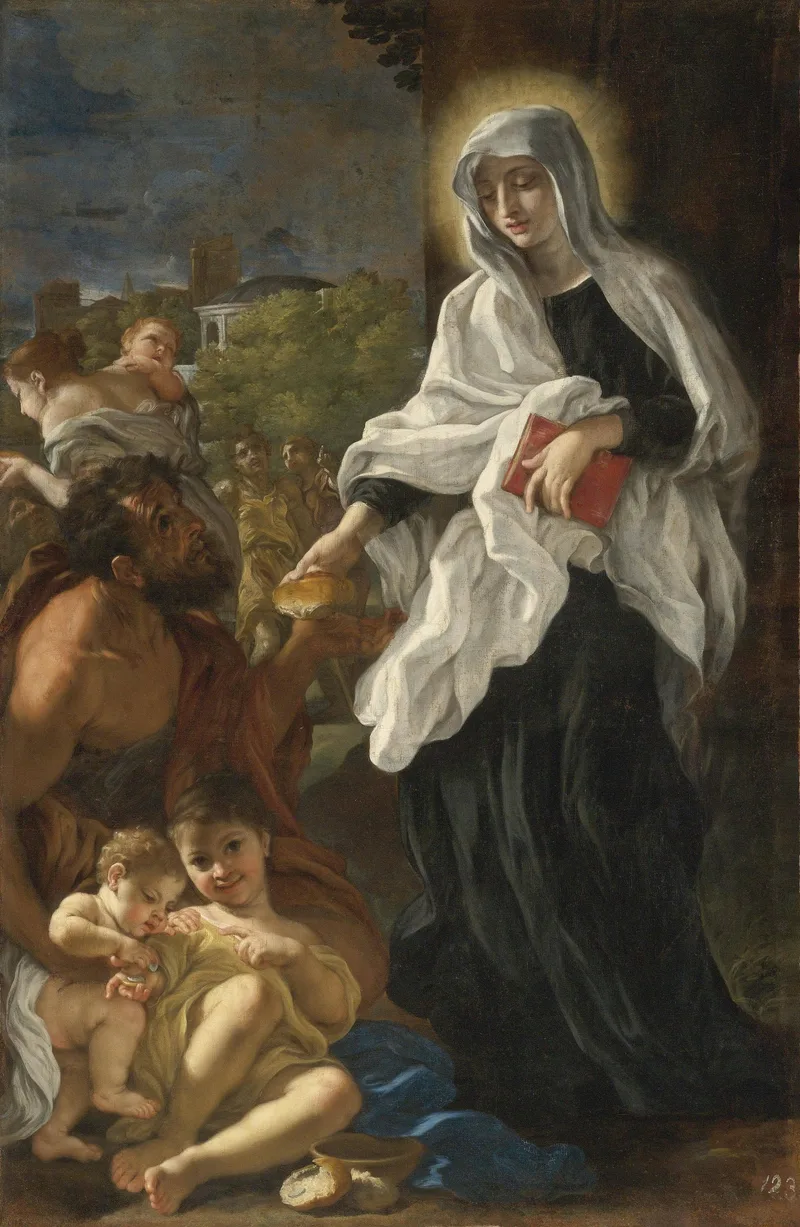
Frances of Rome is identified by an angel. The tradition gives her a permanent attendant, visible to her and understood to be invisible to everyone else, and painters render it as a second figure standing close by. That is an unusual sign in a system built on objects: it moves on its own, it occupies space, and it changes a single-figure picture into a group. Her other conventional marks are plainer — a widow's black and white habit, a book, and acts of charity, which is what the second half of this title records.
What the record holds
The entry is dated 1675 and gives the J. Paul Getty Museum, Los Angeles, CA, US as its location. No dimensions are recorded. It is filed under female portraiture, cultural heritage and religious cultural heritage, with Baroque as the style and Italian as the nationality; the measured colour family is brown.
One name, one entry
Hers is the only title in this catalogue that carries the name Francesca, which places her at the opposite end of the distribution from the wheel-and-keys saints who appear dozens of times. The reason is legible in the attribute itself: a companion angel is not portable between compositions the way a wheel is, and an almsgiving subject needs a cast. Saints whose signs require staging get painted less often than saints whose signs fit in a hand.
Sources
2 references- Gaulli, Giovanni Battista — Getty ULAN
Italian painter, 1639-1709
- Giovanni Battista Gaulli — Wikipedia
Giovanni Battista Gaulli (8 May 1639 – 2 April 1709), also known as Baciccio or Baciccia (Genoese nicknames for Giovanni Battista), was an Italian Baroque painter working in the High Baroque and early Rococo periods. He is best known for hi