Hand-painted in oil
About this Artwork
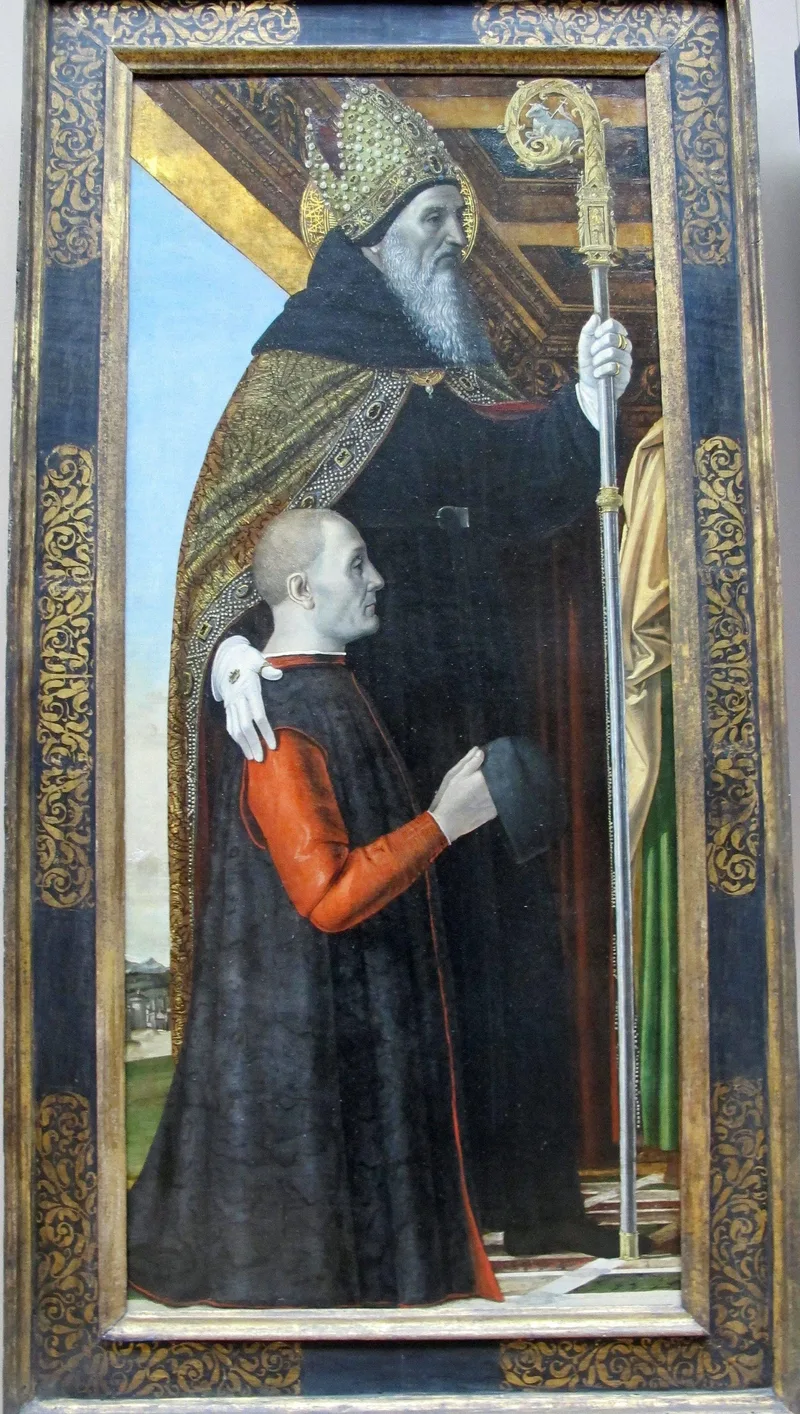
Two people in the title, and only one is a saint
Augustine is identified by the equipment of a bishop — mitre, crozier, a book — and by a flaming heart, which is the emblem the tradition gives him alone. The second figure named here has no attribute at all, because a donor is not a saint. The donor convention is one of the oldest devices in Western religious painting: the person who paid for the picture is included in it, kneeling, in contemporary dress, and often at a smaller scale than the holy figures. It is a signature rendered as a body.
What the record holds
The catalogue dates the panel to 1494 and gives the Louvre in Paris as its location. No dimensions are recorded. It is filed under religious cultural heritage, with Early Renaissance as the style and Italian as the nationality; the measured colour family is blue.
The word in the parenthesis
The title marks this as a detail — a named fragment of a larger composition rather than the whole of one. 7 titles in this collection carry that word, and it changes what a record can be read to mean: the date, the collection and the colour reading belong to the image as catalogued, which is a part standing in for something bigger. The Presentation at the Temple named first is the subject; Augustine and the donor are what this fragment holds.
Sources
3 references- Bergognone, Ambrogio — Getty ULAN
Italian painter, ca. 1460-1523
- Ambrogio Bergognone — Wikipedia
Ambrogio Bergognone (variously known as Ambrogio da Fossano, Ambrogio di Stefano da Fossano, Ambrogio Stefani da Fossano or as il Bergognone or Ambrogio Egogni, c. 1453s – 1523/1524) was an Italian painter of the Renaissance period active i
- Presentation at the Temple — Wikidata
description: painting by Ambrogio Bergognone; inception: 1494-01-17; dimensions: 89 × 76 cm; collection: Department of Paintings of the Louvre